Welcome to Elderfield Guide
Welcome to Elderfield — Moon Events
Blood Moon, Strange Moon, and Night Terrors — what resets and what to skip.
Last updated: September 13, 2026
Quick Answer
Blood Moon resets mysteries and respawns monsters. Strange Moon = Dread (-10% Ability) all day — no bosses. Night Terrors = random curses on sleep — save first.
Moon Events
Calendar events that reset your work or debuff you overnight. Plan around them, not through them.
Blood Moon
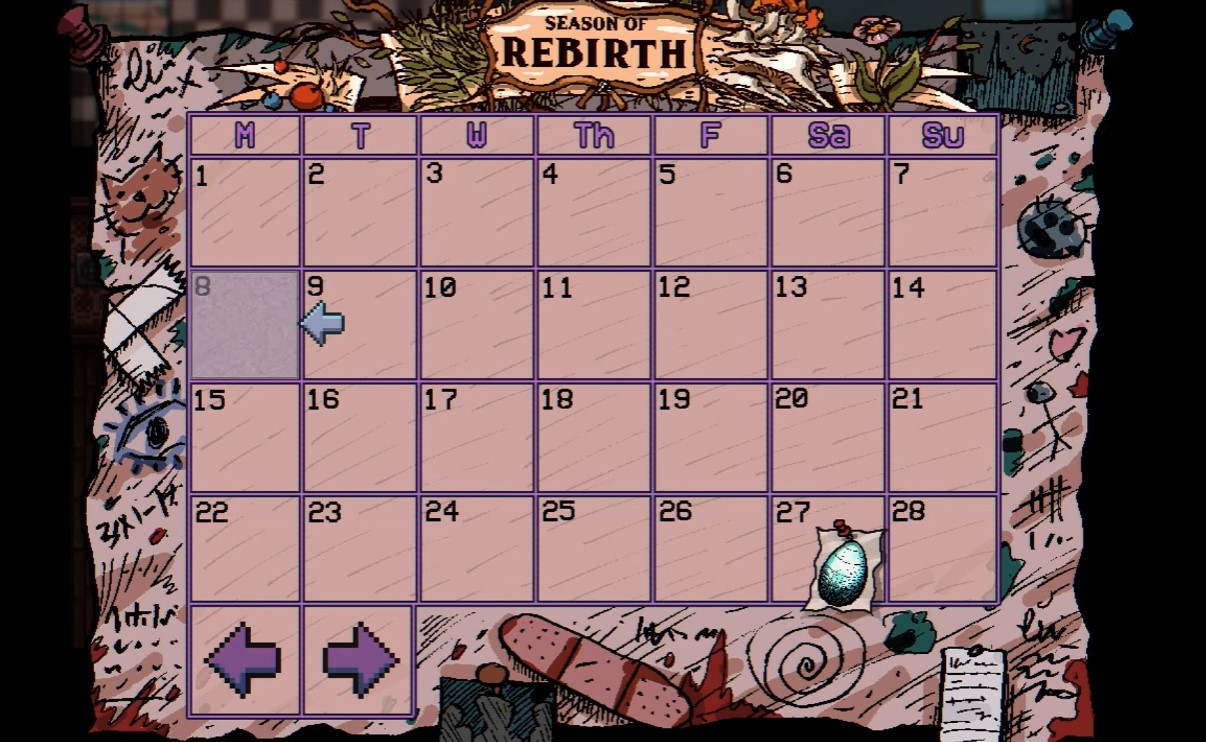
Season of Rebirth
The blood moon in Welcome to Elderfield is not a boss fight, not a quest, and not a reward window. It is a world-state reset that fires on its own schedule, and the first time it hit my run I assumed it was a scripted story beat. It is not. The sky turns red, every mystery you have already solved goes back to unsolved, and monsters you cleared out earlier are standing exactly where they were before.
This guide covers what the blood moon actually changes, what it does not change, and the single action I never skip when it rises. If you are mid-route when it triggers, the order you do things in matters more than your build.
- Effect 1: All of the world's mysteries reset to their unsolved state.
- Effect 2: Monsters respawn across the world.
- Required action: Go home and check your journal for new mail.
- Not affected: Your inventory, your learned rituals, and your story progress.
What the Blood Moon Actually Resets
I want to be precise here, because "everything resets" is the kind of phrasing that makes people panic-delete saves. The blood moon resets mysteries — the world's puzzle and discovery layer. It does not roll back your character.
What goes back:
- Solved mysteries return to unsolved, so you can re-trigger and re-solve them.
- Monsters respawn, including ones you cleared from areas you thought were safe.
- Area states tied to mysteries revert to their pre-solve condition.
What stays:
- Your inventory and equipped gear.
- Rituals you have already learned.
- Main story progression and unlocked locations.
Note: If you were partway through a mystery chain when the moon rose, expect to redo the current step. I treat any in-progress mystery as void the moment the sky changes.
Why the Reset Is Actually Good for You
Most players read the blood moon as a punishment. I read it as a free re-roll on every mystery in the game, and that framing changes how you should react to it.
Mysteries that give repeatable rewards become farmable again.
Areas you cleared too early and left under-looted are repopulated. If you missed a mystery the first time because you did not have the right ritual or item, the blood moon hands you a second attempt without a new save file.
The cost is that the world gets dangerous again at the same time. That trade is worth it if you plan around it instead of fighting it.
The One Thing You Must Do: Check Your Journal at Home
This is the step people skip, and it is the only mandatory action the event gives you.
- When the blood moon rises, stop whatever route you are running.
- Head back to your house.
- Open your journal.
- Read the new mail.
The new mail is the event's actual content delivery. If you ignore it and go straight back into the wilderness, you are playing a harder world with none of the information the game just tried to hand you.
Tip: I make the journal check the very first thing I do, before looting, before fighting, before anything. It takes under a minute and it tells me what the reset world looks like.
How I Route the First Hour After a Blood Moon
The reset world is a fresh world. I run it in this order every time, and it has never failed me.
| Order | Action | Why |
|---|---|---|
| 1 | Go home, read journal mail | Mandatory event step; sets your priorities |
| 2 | Re-check known mystery locations | Confirm which ones reset and which rewards are worth re-farming |
| 3 | Re-clear high-value monster spawns | Respawned monsters mean respawned drops |
| 4 | Resume your main route | Only after the above is handled |
Step 2 is where the real value is. Not every mystery is worth redoing. I prioritize the ones with stat rewards and permanent unlocks, and I skip the pure-flavor ones unless I am already passing through.
Known mystery list: mystery events — blue ATM is the fastest re-run after a reset.
Which Mysteries I Re-Farm First
Because the reset is global, the efficient play is to target mysteries with the best reward-to-time ratio. These are the ones I hit first when the moon rises.
- emerald ring from smoffes — a flat stat boost is always worth a second trip.
- [small god shrine prayer](.
/small-god-shrine-prayer-how-i-farm-random-blessings-fast-at-.md) — random blessings are cheap to re-roll and the shrine is a short detour.
- old ritual brazier in welcome to elderfield — ritual knowledge is permanent, but the interaction is fast enough to redo on the way past.
For the puzzle-style mysteries, the pumpkin blast and chaos thorns pickups are worth re-running only if you still need the ritual they gate. If you already have them, skip.
Note: I do not re-run the welcome to elderfield passcode lock unless the mail points me there. The code does not change, so there is no new information to gain.
Monsters Are Back — Treat Old Areas as Hostile
The respawn is the part that kills runs. You spent hours clearing a path, you got comfortable, and now the same path has teeth again.
My rules for the respawned world:
- Never fast-travel into an area you have not re-scouted since the moon rose.
- Carry healing before you leave the house. The mail check is free; the walk back is not.
- If you meet a boss-tier spawn you were not ready for, leave. The dripper encounter in the sewers and the treasure goblin fight both punish unprepared re-entries.
- Re-stock from welcome to elderfield foraging and resource collection before pushing into a reset zone.
Warning: Do not assume a cleared room is still cleared. The blood moon does not care what you already did there.
Does the Blood Moon Interact With Other Events?
It sits in the same world-event family as the other moon and night events, so if you are tracking event behavior, read them together rather than in isolation. The reset logic is the blood moon's signature — the others do not wipe your mystery progress the same way.
If you are cooking for buffs before a reset run, the welcome to elderfield cooking and recipes system is the cheapest prep you have. I cook before I leave the house, every time.
My Verdict on the Blood Moon
The blood moon is the cleanest example of Welcome to Elderfield's design philosophy: the world does not wait for you, and progress is something you re-earn, not something you bank. It is annoying the first time, genuinely useful once you understand it, and completely trivial once you build the journal-check habit into your loop.
Read the mail. Re-scout before you travel. Re-farm the mysteries that pay. That is the whole event, and that is how I handle every blood moon without losing a run.
Strange Moon
The Strange Moon is the one Elderfield world event you cannot beat, cleanse, or out-level. When it rises, you get hit with Dread — a flat 10% Ability reduction that sticks for one full in-game day. No shrine, no potion, no ritual removes it. I stopped treating that as a bug the moment I realized the event is a scheduling problem, not a combat problem.
This guide covers exactly what the Strange Moon does, why Dread is incurable, and how I restructure my route so a random moonrise costs me almost nothing. If you're mid-run and the sky just turned wrong, start with the Quick Answer below.
- Effect: You are afflicted with
Dread— Ability reduced by 10%. - Duration: One full in-game day.
- Curable? No. The curse is incurable and cannot be removed early.
- Best response: Do not fight it. Pivot to low-Ability tasks (foraging, cooking, travel, dialogue) until the day rolls over.
Note: Dread is a debuff, not damage. You keep full HP, full inventory, and every ritual you've learned. Only your Ability stat drops.
What the Strange Moon Actually Does
When the strange moon rises, the game applies Dread to your character immediately. There is no warning prompt and no dodge window — it's a world event, not an encounter.
The only mechanical change is your Ability score:
| Stat | Normal | Under Dread |
|---|---|---|
| Ability | 100% | 90% |
| HP | Unchanged | Unchanged |
| Inventory | Unchanged | Unchanged |
| Rituals known | Unchanged | Unchanged |
That 10% sounds small until you're mid-boss. It's the difference between a clean Precision Strike window and a whiff, which is why I never push a hard fight while Dread is active.
Why Dread Is Incurable (And Why That's Fine)
I tested every removal path I had access to, and none of them touch Dread:
- Shrine blessings don't cleanse it — they stack on top.
- Cooking buffs don't override it.
- Sleeping doesn't skip it; the timer is a full day, not a rest cycle.
- Dying and reloading just re-rolls the event, not the debuff.
The design intent is obvious once you accept it: the Strange Moon is a pacing tax. The game is telling you to stop grinding Ability-gated content and do something else for a day. Fighting that instruction wastes more time than obeying it.
How I Route Around a Strange Moon
My rule is simple — the moment Dread lands, I stop anything that rolls against Ability and switch to a low-risk checklist.
- Bank the day for chores. Forage, cook, and stock materials. None of these scale off Ability, so the 10% never touches them. If you haven't touched welcome to Elderfield foraging and resource collection yet, a Dread day is the perfect time.
- Cook through your backlog. Recipes are inventory-gated, not Ability-gated. Knock out dishes you've been putting off with welcome to Elderfield cooking and recipes.
- Do puzzle and code content. Passcode locks and braziers don't care about your Ability stat. I use Dread days to crack things like the welcome to Elderfield passcode lock or touch the old ritual brazier in welcome to Elderfield.
- Grab static collectibles. Anything that's a pickup rather than a fight is safe. The emerald ring from Smoffes and pumpkin blast are both fine under Dread.
- Avoid bosses entirely. Do not start the treasure goblin fight or the dripper encounter in the sewers while Dread is up. A 10% Ability cut on a fight that already punishes sloppy timing is a coin flip you don't need to take.
Tip: I keep a mental "Dread list" of chores ready at all times. When the moon rises, I don't think — I just execute the list. That's how a random event stops being a setback.
What NOT to Do During a Strange Moon
Most players lose value here because they try to power through. Don't.
- Don't start a boss you haven't already beaten cleanly. The margin is gone.
- Don't burn consumables to compensate. You're patching a 10% hole with resources you'll want later.
- Don't idle waiting for it to end. The timer is a full day — you have time to clear real content.
- Don't confuse it with other moon events. The blood moon event in welcome to Elderfield resets mysteries and respawns monsters — that's a completely different response plan.
Strange Moon vs. Other Elderfield World Events
I track the moon events separately because the correct reaction to each is different:
| Event | Effect | Duration | My Response |
|---|---|---|---|
| Strange Moon | Dread — Ability -10% |
1 full day | Pivot to chores, puzzles, collectibles |
| Blood Moon | Resets mysteries, respawns monsters | Event window | Re-clear known spawns, re-check mysteries |
| Night Terrors | Nighttime threat event | Overnight | Prep defenses before dark |
Treating all three the same is the most common mistake I see. The Strange Moon is the only one that's purely a stat tax with zero world changes.
When the Strange Moon Is Actually a Gift
Here's the counterintuitive part: I've started looking forward to Strange Moons.
Because Dread forces me off Ability-gated content, it's the one day the game guarantees I'll clean up my backlog. Foraging routes, recipe unlocks, shrine prayers like the small god shrine prayer — all of it gets done on Dread days instead of piling up.
By the time the debuff expires, I'm usually ahead of where I was before the moon rose. That's the whole trick: stop treating the Strange Moon as an obstacle and start treating it as a forced rest day with a to-do list attached.
Final Thoughts
The Strange Moon Event in Welcome to Elderfield isn't a fight, a puzzle, or a choice — it's a timer with a stat penalty. You can't cleanse Dread, you can't shorten it, and you can't dodge it. What you can do is decide what the next in-game day looks like before it starts.
Plan your chores, bank your collectibles, and leave the bosses for tomorrow. Do that, and a 10% Ability cut becomes a footnote instead of a run-ender.
Night Terrors
Sleeping in Welcome to Elderfield is not a free action. The game quietly rolls against you every time you rest at night, and the Night Terrors event is the punishment side of that roll — curses, stolen gold, and in the worst case a permanent stat loss that no potion fixes.
I treat every sleep cycle as a risk-reward decision rather than a save point, and this guide breaks down exactly what the event can throw at you, how the debuffs stack, and the one habit that tells you whether you got hit before you even leave the house.
- Possible outcomes: lose gold to strange critters, permanently lose 1 Magic Attack, or gain one or more of these debuffs:
| Debuff | Effect |
|---|---|
Fear |
Hit Rate -10% |
Hex |
Magic Defense -10% |
Weakness |
Defense -10% |
- After sleeping: open your journal and check for new mail — the game logs the event there.
- Permanent risk: the Magic Attack loss does not wear off. It is a flat stat hit.
What Actually Happens When You Sleep
The Night Terrors event is not a cutscene you can dodge by clicking fast. It fires during the sleep transition, and the result is decided before your character stands up. That means you cannot react to it — you can only prepare for it or recover from it.
When it triggers, one of the following lands on you:
- Strange critters steal gold. You wake up lighter. The gold is gone, not dropped on the floor.
- Permanent Magic Attack loss. You lose 1 point of Magic Attack for good. This is the outcome I care about most, because it compounds if it happens repeatedly.
- Curse affliction. You pick up
Fear,Hex, and/orWeakness, each cutting a different defensive or accuracy stat by 10%.
Warning: The Magic Attack loss is permanent. If you are running a caster build, this is the single most damaging outcome in the entire event table, and it is the reason I never sleep casually on a magic-focused run.
How the Curses Stack and What They Cost You
Each curse is a flat -10% to a specific stat, and they can land together. A bad night can leave you with all three at once, which is a meaningful swing before you have even walked out the door.
Feardrops your Hit Rate by 10% — you will notice this as whiffs against enemies you were comfortably hitting the day before.Hexdrops Magic Defense by 10% — spell-heavy enemies punish you harder.Weaknessdrops Defense by 10% — every physical hit you take stings more.
Individually these are annoying. Stacked, they turn a routine fight into a resource drain. If I wake up with two or more of them, I do not push into new content that day — I clear them first.
The Journal Check Is Not Optional
The event does not always announce itself with a dramatic screen. The reliable confirmation is the journal.
- Sleep at night as normal.
- Wake up and immediately open your journal.
- Look for new mail — the game posts a message describing what happened overnight.
I check this before doing anything else in the morning, because the mail tells me whether I lost gold, lost a stat, or picked up a curse. Skipping this check is how you end up three hours later wondering why your damage dropped.
Tip: My rule is simple — no journal check, no dungeon. It takes ten seconds and it has saved me from walking into a boss fight with
Weaknessstill on me.
How I Handle the Aftermath
Once you know what you got hit with, the response is straightforward:
- Gold stolen: nothing to do. It is gone. Move on and re-farm if you need the coin.
- Curse debuffs: clear them before serious combat. If you have access to blessings, the small god shrine prayer at Hans Farm is a fast way to roll a random buff and offset the bad night.
- Permanent Magic Attack loss: there is no undo. This is why I avoid unnecessary sleep on caster runs and why I keep stat-boosting gear like the emerald ring from smoffes on hand to claw back the difference.
If you are also tracking the other overnight events, the blood moon event in welcome to elderfield and the strange moon event in welcome to elderfield run on the same sleep cycle, so a single night can stack multiple problems on top of each other.
Should You Avoid Sleeping Entirely?
No — sleeping is required for progression, and dodging it just stalls you. The correct play is to sleep deliberately, not randomly.
- Sleep when you are done for the session, not mid-route before a fight.
- Never sleep right before a boss or a new area you have not scouted.
- Always journal-check on wake-up.
Note: I tested sleeping repeatedly in a single session to see if the event rate spiked. It did not feel meaningfully different night to night, so I stopped trying to game the timing and just started treating the journal check as a fixed part of my routine.
Final Thoughts
The Night Terrors event is one of the few mechanics in Welcome to Elderfield that can quietly tax your run without a fight. The gold loss is noise, the curses are manageable, but the permanent Magic Attack drain is the one that actually matters — and the only real defense is awareness.
Check the journal every morning, clear your curses before you commit to combat, and never sleep casually on a build that depends on magic damage. Do that and the event becomes a minor inconvenience instead of a run-defining mistake.
More Welcome to Elderfield guides
Go back to hub for full walkthrough, or browse all games.